
Timeline
Ongoing
2025
Sign Game Labs
Team
Design Team
UI/UX Team
Art Team
Role
Marketing & Branding Lead
Tools
Figma
Adobe Illustrator
Webstudio
Overview
Approximately 95% of deaf children are born to hearing parents who do not know American Sign Language. Lack of exposure to language during critical development stages can lead to Language Deprivation Syndrome, leading to behavioral and cognitive problems later on. Primary barriers for parents learning ASL include the increased difficulty of learning a new language later in life and the challenge of fitting regular ASL lessons into an already busy schedule. Therefore, learning ASL at their own time and pace is highly desirable.
With these concerns in mind, the Georgia Institute of Technology and National Technical Institute for the Deaf collaborated to develop PopSign, an arcade-style bubble shooter game that integrates an ASL sign language recognizer. Users sign to their device camera, and the recognizer identifies these signs to allow users to shoot and pop bubbles practicing sign recognition and production skills.
A practice video showcases the signs for the upcoming level.
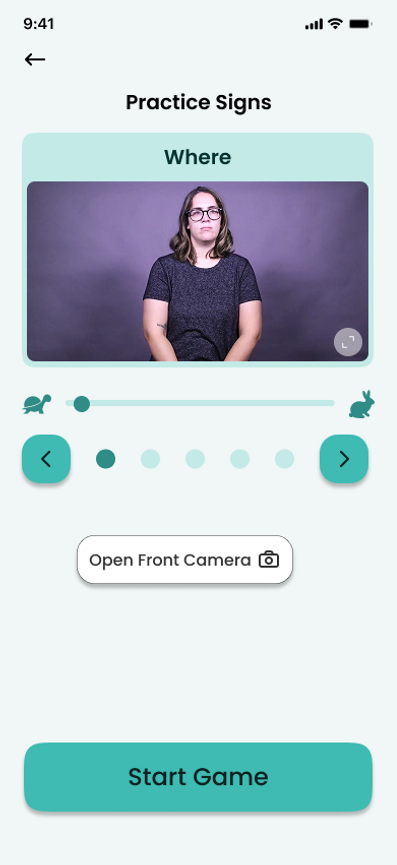
Users can now attempt to sign to load a bubble and shoot. The black rectangle is what the camera would show.


Slide screenshots from our 2-hour branding sprint
Process
When first joining the project, PopSign and PopSignAI were the only games using the recognizer, and both were in the process of having their designs revamped to appeal to a modern audience. With our recognizer improving at every update and accessibility being our goal, we believed our toolkit shouldn't be limited to just PopSign. Many developers could implement the recognizer into their game and make sign language learning more accessible. Sign Game Labs became the name we would use to distribute these tools.

Sign Game Labs required new branding and would include more about our overall research, with PopSignAI being the primary game. I led a branding sprint with our directors and team leads to refocus our values and roadmap. We settled on "Spread the knowledge, awareness, and opportunity" to be our motto and showcase our values.
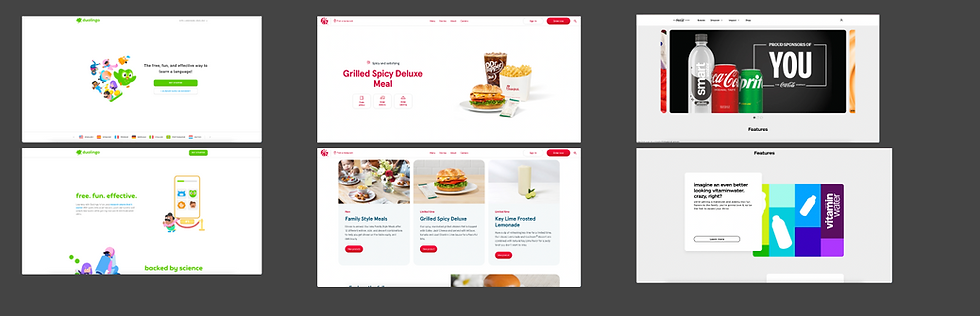
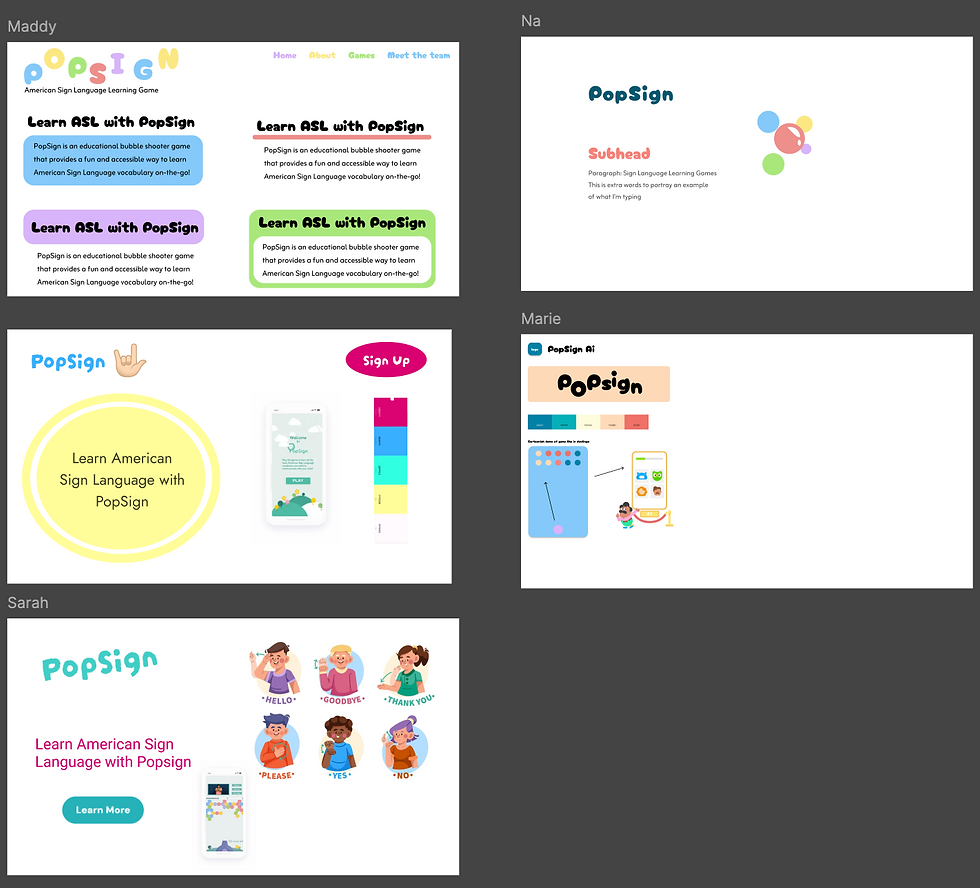
With the new values in mind, I tasked my team with gathering references across multiple brands. We would break down each of them into components we liked and why we believed they worked well. Afterwards, we each made a quick mockup of a landing page.
I wasn't too satisfied with the outcome, as my team members were all beginners in the field. Instead, I broke it down further and tasked them with finding color palettes and font families. During this period, I created lectures on using Figma's prototyping tools.

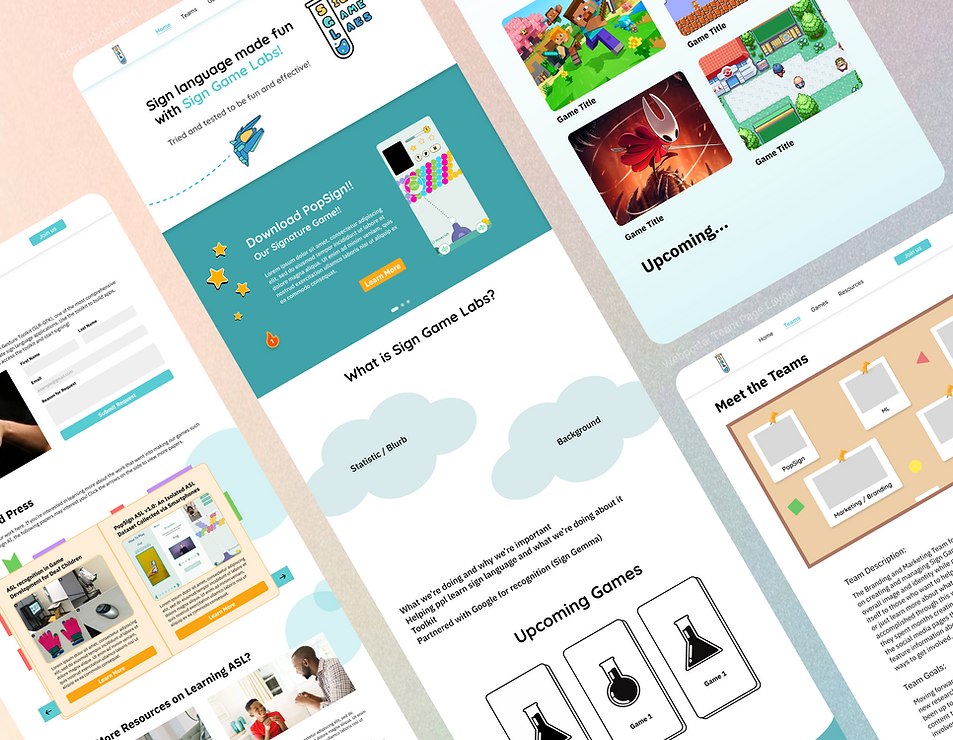
After analyzing my members' strengths, I redistributed them into 3 teams: social media, web interface, and backend functions. The social media team handled content creation and social media visuals. Web interface members worked on the website's layout, UI/UX, and design, while backend functions implemented the design into a functional website. For the sake of space, I will not break down each team's work, so here are glimpses of what each team was able to work on.

Reflection
Working at Sign Game Labs gave me the opportunity to build a meaningful brand from the ground up. There's still more development that can be done since the website has not been fully launched. I plan to interview each team within Sign Game Labs and highlight the meaningful work members have contributed across every aspect. I hope to add resources so others can build off research that has been completed in order to further studies in the Sign Language field.
While the branding is nearing completion, I'm excited to learn and experience social marketing to spread awareness of the SGL name and its mission.